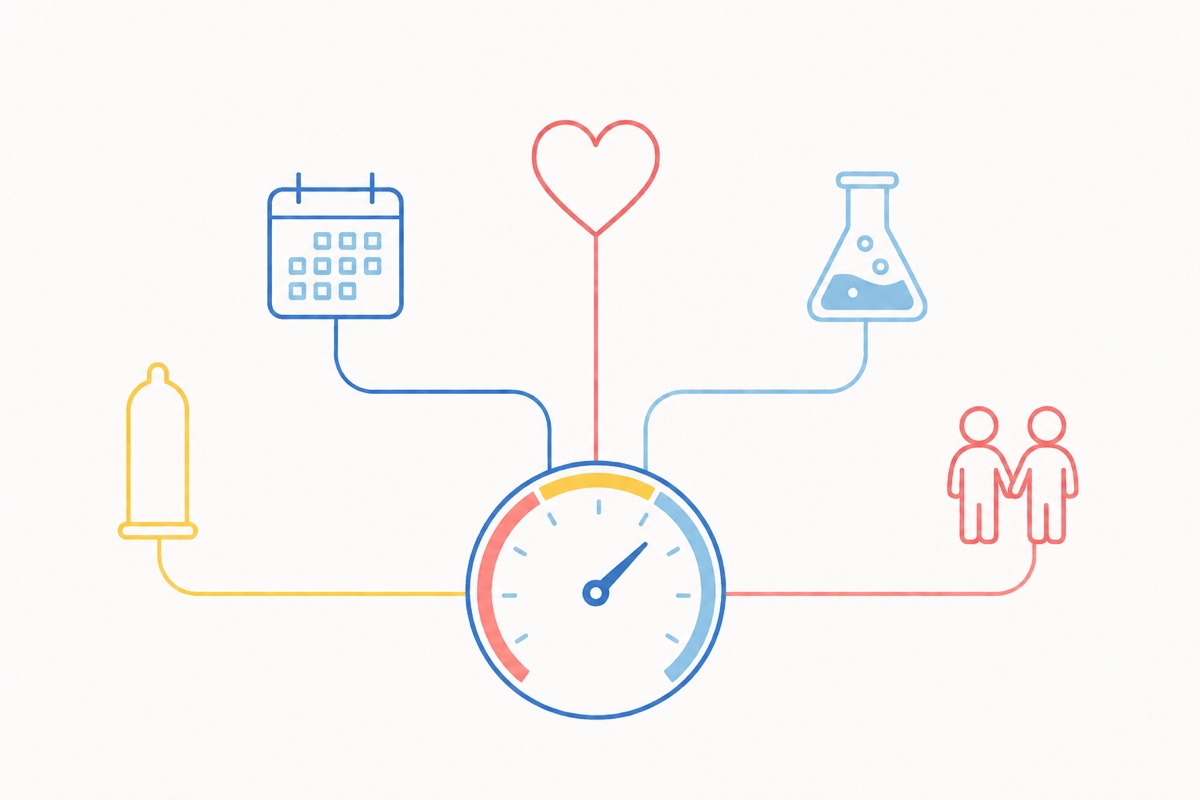
Most of us carry around a vague, background hum of worry about STIs. Not a number, not a plan, just a feeling that flares up after a new partner and fades when life gets busy. That worry is rarely accurate. It spikes when there's nothing to worry about and goes quiet exactly when a test would be smart.
Your safety score is the antidote to that hum. Instead of a feeling, it gives you a single, honest read on where you actually stand: per STI and overall. This article explains what the score is, what moves it, why it changes over time, and how to nudge it in the direction you want.
In this article
What a safety score actually is
Your safety score is an estimate of how likely it is that you currently have an STI, expressed as a single number you can glance at and understand. Play Safe works it out from the things you log: your testing history, the partners you've been with, the kind of sex you've had, and how you protect yourself.
A higher score means a lower estimated chance of currently carrying an infection that's worth acting on. A lower score means the odds are higher and it's probably worth getting tested or having a conversation. That's it. It's a compass, not a verdict.
Here's the most important thing to say up front: your safety score is not a judgment, and it is not a grade on you as a person. It doesn't measure how "clean" or "responsible" or "good" you are. Plenty of careful people have lower scores at times, and plenty of risky behaviour goes unpunished by luck. The score reflects probabilities, not morality. It exists to help you decide what to do next, not to make you feel one way or another about yourself.
Risk is not random
It's tempting to treat STIs as bad luck: something that either happens to you or doesn't, with no rhyme or reason. That's not how it works. STI risk comes from a handful of real, knowable factors. Some push it up, some pull it down, and most of them are things you already have a sense of.
That's good news, because anything driven by knowable factors can be estimated, and anything that can be estimated can be improved. The rest of this article walks through those factors one at a time, then shows you which levers are in your hands.
The factors that move your risk
Play Safe weighs each of these together. No single one decides your score on its own. Here's how each one tends to pull, in plain terms.
How many partners, and how recent
More partners means more chances for an infection to reach you, so a higher partner count tends to push your risk up. But the details matter just as much as the count, and the biggest one is testing. A partner who tested negative recently barely registers: there is strong, current evidence about their status. A partner whose last test was a long time ago (or who has not tested) carries more weight, because there is more uncertainty about what they might be carrying now. Risk does not fade on its own as time passes; what changes is that an old test tells you less about someone's status today than a recent one does.
The kind of sex you have
Not all sex carries the same risk. Different acts have very different chances of passing an infection along, and Play Safe accounts for that rather than lumping everything together. Unprotected anal sex, for example, carries a much higher transmission risk for several STIs than other activities. And here's one people often miss: oral sex counts. Chlamydia, gonorrhea, syphilis, herpes, and HPV can all be passed through oral sex, so the app factors it in too. For more on how each STI spreads, see the basics.
Protection use and consistency
Protection is one of the strongest levers you have. Condoms, used correctly and consistently, sharply lower transmission risk for most STIs, so logging protected encounters pulls your score in a good direction. Consistency is the key word: occasional use helps far less than every-time use. PrEP dramatically reduces the risk of getting HIV specifically. It's worth knowing that condoms work less well against infections that spread by skin-to-skin contact (like HPV and herpes), because those can reach areas a condom doesn't cover. Play Safe reflects that nuance rather than pretending protection is all-or-nothing.
Your last test, and what it showed
A recent test result is the single most powerful piece of information in the whole picture. A recent negative test resets your estimate close to zero for the STIs it covered: it's strong evidence you don't currently have them. That's why getting tested is the fastest way to raise your score. The catch is that a test only tells you about the moment it was taken. It can't account for anything that comes afterwards, so every new encounter since your last test starts building your estimate up again. More on that in the next section.
Your partners' habits and testing
Your risk doesn't only depend on you. A partner who tests regularly, uses protection, and has few other partners brings far less risk to the table than one who doesn't. Play Safe lets you record what you know about each partner, and that information shapes your estimate. Even better, if a partner also uses Play Safe, the two of you can link so you can share your safety status directly with each other, no awkward guessing required. When a partner shares their real status this way, your estimate gets a lot sharper because it's based on their actual data instead of an assumption. Linking happens privately and only with people you choose.
Where you are, and base rates
Some STIs are simply more common in some places and some populations than others. These background rates (what epidemiologists call prevalence) form the starting point for any estimate, before your personal history adjusts it up or down. Play Safe uses base rates drawn from public health data so that the same behaviour is weighed sensibly for your situation rather than against a single global average.
Vaccination
For the STIs you can be vaccinated against, vaccination changes the picture in your favour. The HPV vaccine and the hepatitis B vaccine are both highly effective, and being vaccinated meaningfully lowers your risk for those specific infections. If you're not sure whether you're covered, it's a good question for your doctor.
Why your score changes over time
Your score isn't frozen at the moment you last checked it. It moves as your life does: a new encounter can lower it, a fresh negative test raises it back up, and new information about a partner can move it either way. It always reflects your best current estimate rather than a one-time snapshot.
Think about what a negative test actually tells you: strong evidence about your status on the day you took it, and nothing about what comes after. Every encounter in the weeks and months that follow adds to your estimate again. The same logic is even more important for your partners: the longer ago someone last tested, the less their result says about their status today, so the more weight the model gives to the chance that something has changed since. Recent evidence is strong; old evidence is weak.
This is why the score is a living thing rather than a static label. It's also why "I tested negative last year" isn't the reassurance it feels like: a year is plenty of time for new encounters, and an old result says little about your status now. The same logic applies to a partner's old test. What moves the estimate isn't the calendar by itself, but new activity and the simple fact that old information is less reliable than recent information.
Per-STI versus overall
STIs don't all behave the same way, so it wouldn't make sense to score them with one rule. Some are curable bacterial infections that a course of antibiotics clears completely. Others are lifelong viral infections that are managed rather than cured. They spread through different routes, at different rates, and respond to testing and protection differently.
Because of that, Play Safe estimates your risk for each STI separately, then rolls those individual estimates up into one overall score. The per-STI view lets you see exactly where any concern is concentrated, while the overall score gives you the at-a-glance summary. It also weighs more serious infections more heavily, so the overall number reflects not just how likely an infection is, but how much it would matter.
What you can actually do
Here's the empowering part. Almost every factor that moves your score is something you have some control over. These are the levers, roughly in order of impact:
- Get tested. Nothing raises your score faster or more honestly than a recent negative result. If you're unsure when or what to test for, Play Safe gives you personalized advice, and you can read more about how the process works in getting tested.
- Use protection, consistently. Every-time use is what moves the needle. Don't forget barriers for oral sex too, not just penetrative.
- Be thoughtful about partners. Fewer concurrent partners, or partners who test regularly and protect themselves, both lower your risk. Quality of information matters: a partner whose status you actually know beats one you're guessing about.
- Get vaccinated. The HPV and hepatitis B vaccines are a one-time investment that lowers your risk for those infections for good.
- Talk to your partners. Honest conversations are how you learn the things that sharpen your estimate, and they're easier than they sound. Our guide to talking about it has practical scripts.
If you want a structured way to build these habits and watch your score respond, our guide to leveling up turns them into a routine.
A note on honesty and privacy
Two things are worth being clear about. First, the score is only as good as what you tell it. Skipped encounters, rounded-down partner counts, or protection you log as used when it wasn't all make the estimate less accurate, and the only person that misleads is you. The score isn't there to be impressed. It's a tool for your own decisions, so an honest log is a more useful one.
Second, this is your private business. Your safety score and everything that feeds it are computed right on your device. Play Safe is offline-first, which means your logs, your history, and your score live with you, not on a server somewhere. There's no number to perform for and no one to perform it for. Even when you choose to link with a partner, you control what's shared and with whom.
The takeaway
A safety score doesn't make STI risk disappear, but it does something almost as valuable: it turns a vague, draining worry into a clear picture you can act on. You learn where you actually stand, what's driving it, and which small, doable steps will move it.
Check it, understand it, and let it guide your next test or your next conversation. Then get on with enjoying your life. You've got this.
Track your sexual health with Play Safe
Log your activity, track your tests, and get a personalized safety score. All privately on your device.